Tasting the Past
In the Indo-Guyanese kitchen, every dish carries a story across oceans. This showcase maps six traditional dishes to the six weeks of our course — because cooking and writing share the same transformative craft.
"Each recipe serves as an intimate journal entry in which older women are able to concretize their innermost thoughts and feelings, working collaboratively with the younger women to articulate these feelings, under the guise of recipe sharing."— Brinda Mehta, 2004
The Kitchen as Archive
When indentured workers boarded ships from Calcutta to British Guiana, they carried bundles of spices against their chests. These were not just flavoring — they were memory, medicine, and identity compressed into small cloth packages. Over five generations, those spices became the foundation of a cuisine that is neither Indian nor Caribbean, but something entirely its own.
In our course, we use food as a lens for understanding how family stories are preserved, adapted, and passed down. Each week maps to a dish — and each dish teaches us something about the craft of writing our histories.
Context & Era
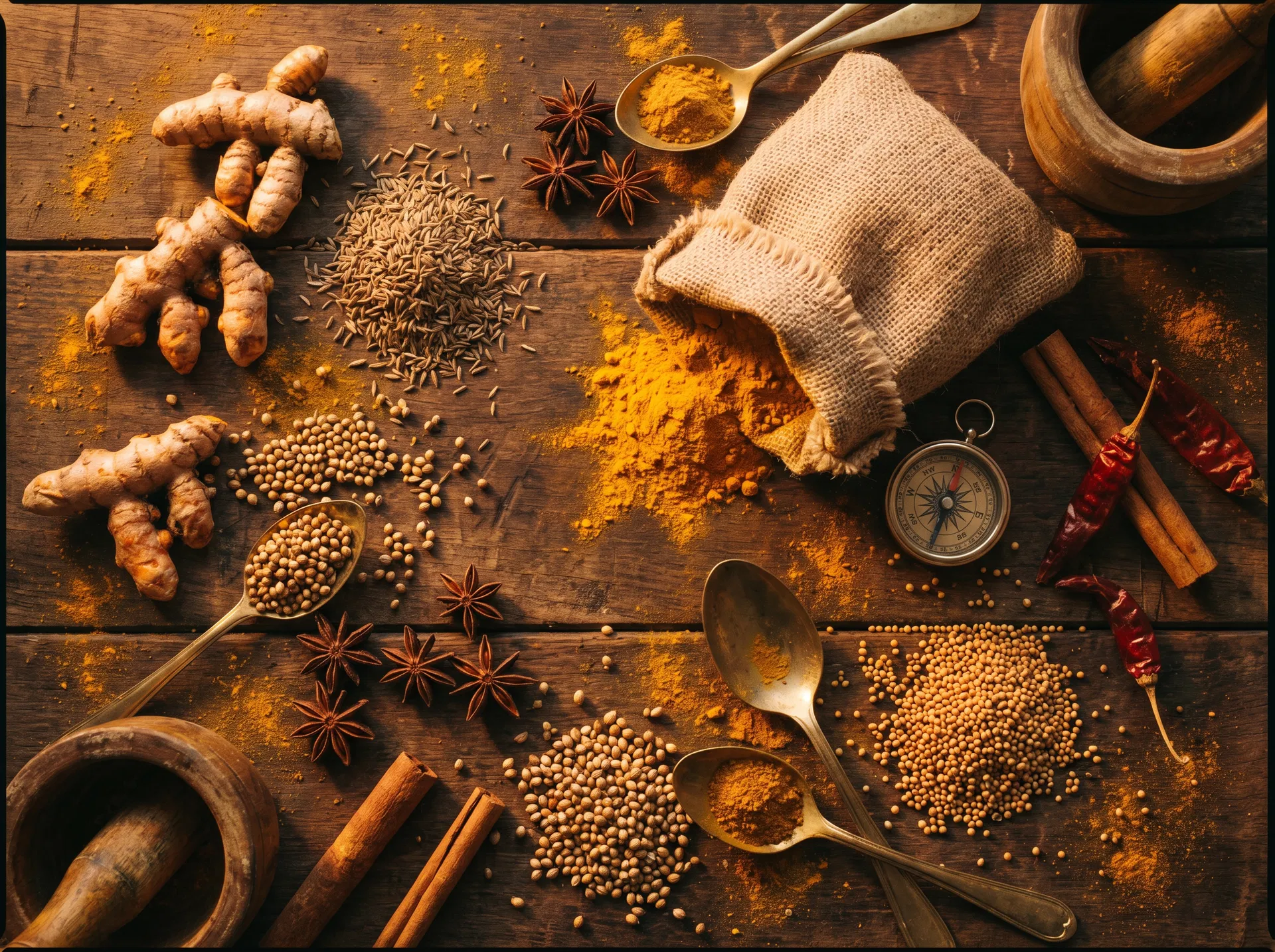
The Spice Bundle
Turmeric, cumin, coriander, chillies
Indentured workers crossed the kala pani clutching bundles of spices to their chests — protection against the ship's foul smells, but also a piece of home for an unknown exile. These raw ingredients are the foundation of every dish, just as understanding the historical era is the foundation of every family story.
In the Kitchen
The spices carried from India to the Caribbean were not random. Turmeric for vitality, cumin for digestion, coriander for cooling — each chosen with purpose. When they arrived in British Guiana, some spices could not be found, so new ones were adopted: cassareep from the Amerindians, scotch bonnet from the Africans. The pantry became a record of migration itself.
At the Writing Desk
In Week 1, we gather our raw materials: the dates, the places, the names. Like spices before they meet oil, these facts are potent but uncooked. We learn to read the era that produced our family's records — and the silences those records contain.
Roles & Values
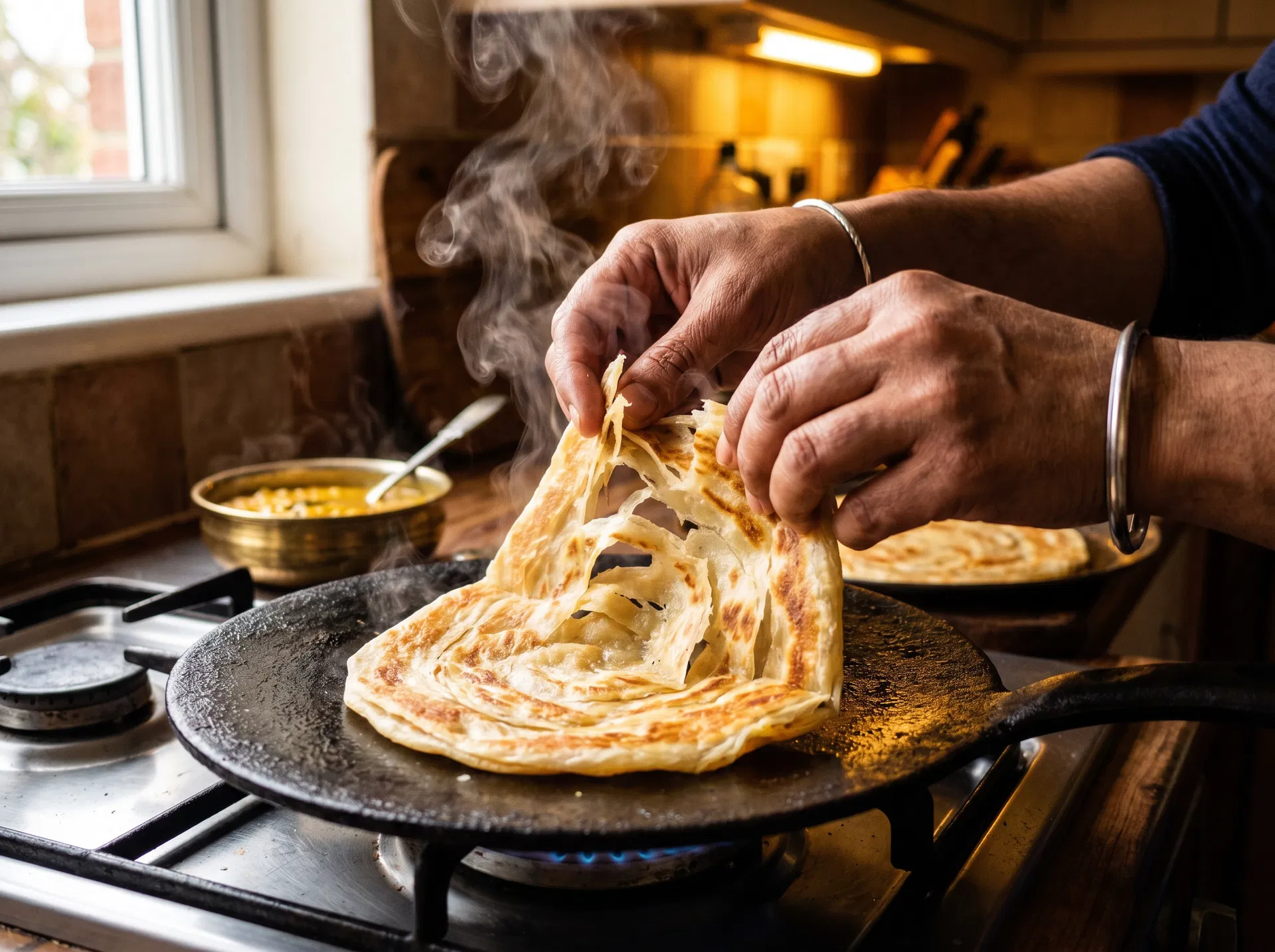
Roti
The layered bread of the Indo-Caribbean kitchen
Indo-Guyanese roti is not flat bread — it is architecture. Layer upon layer, folded and pressed on the tawa, each fold representing a generation's adaptation while the core remains intact. A grandmother's hands know exactly when to turn it, how much oil to brush, when the layers are ready to separate.
In the Kitchen
The roti that arrived in the Caribbean evolved from the Indian paratha. In Guyana, it became its own tradition — thinner, flakier, cooked on a cast-iron tawa passed down through families. The technique is taught hand-to-hand, mother to daughter, auntie to niece. No recipe book captures the feel of the dough or the sound of the right sizzle.
At the Writing Desk
In Week 2, we explore the layers of family roles and values. Like roti, families have visible surfaces and hidden folds. We learn to peel back the layers — the expectations placed on eldest sons, the quiet strength of grandmothers, the values that survived migration and the ones that transformed.
Rituals & Artifacts
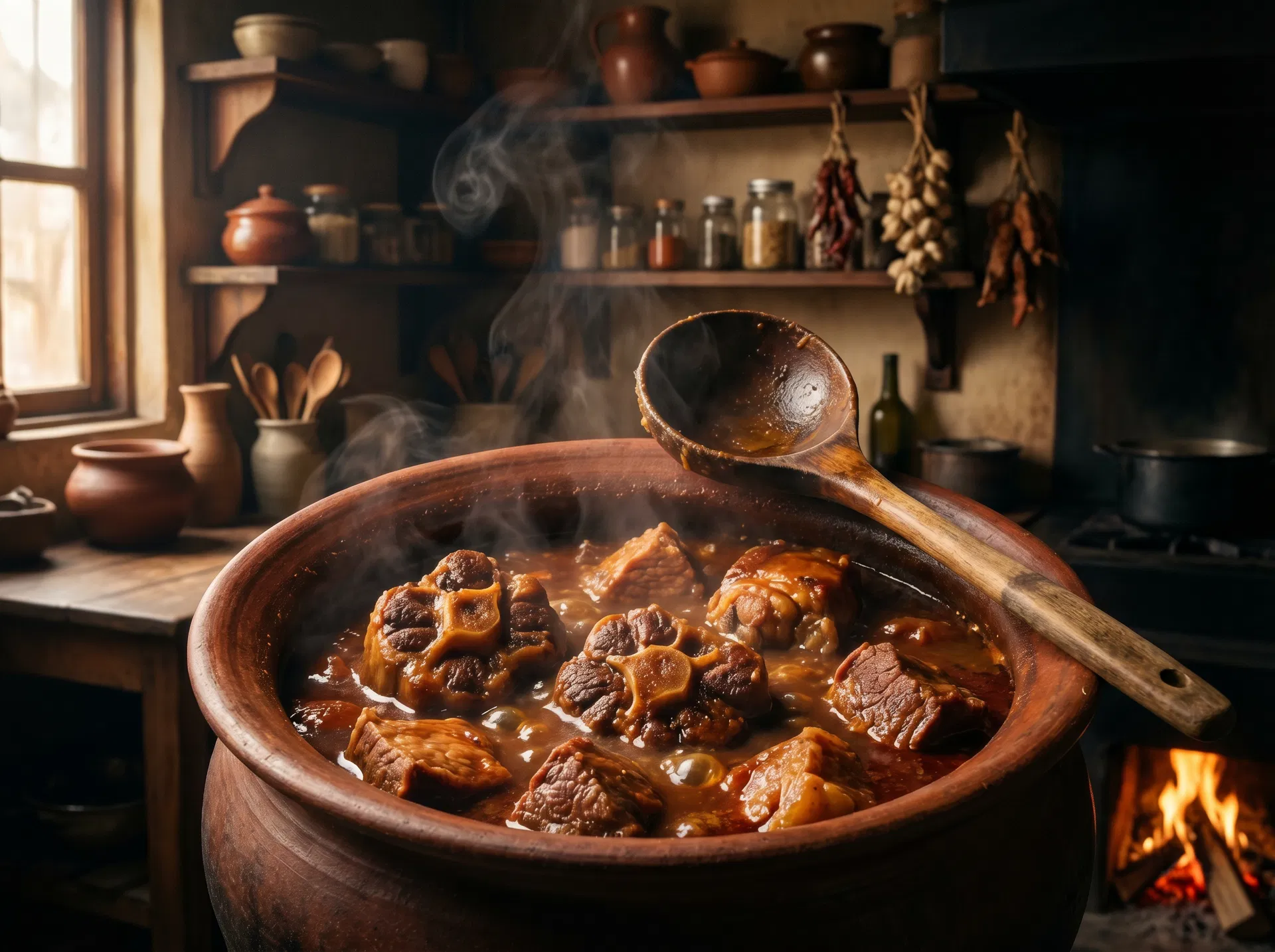
Pepperpot
The never-ending stew of Guyana
Pepperpot is Guyana's national dish — and its defining quality is that it never ends. A good pepperpot is kept going for days, weeks, even months, with new meat and cassareep added to the pot. The base deepens with time. Like family rituals, it is both ancient and ever-renewing.
In the Kitchen
The cassareep — a thick, dark syrup extracted from bitter cassava — is the soul of pepperpot. It was an Amerindian innovation, adopted by Indo-Guyanese families who added their own spices: cinnamon, cloves, and hot peppers. The dish itself is a record of Guyana's multicultural history, each ingredient a chapter from a different people.
At the Writing Desk
In Week 3, we explore the rituals and artifacts that persist across generations. Like pepperpot, family traditions have an unchanging core (the cassareep) and evolving additions (each generation's new ingredients). We learn to identify what endures and what transforms — pujas, wedding customs, holiday foods, the objects kept in drawers.
Craft: Bringing Relatives to Life
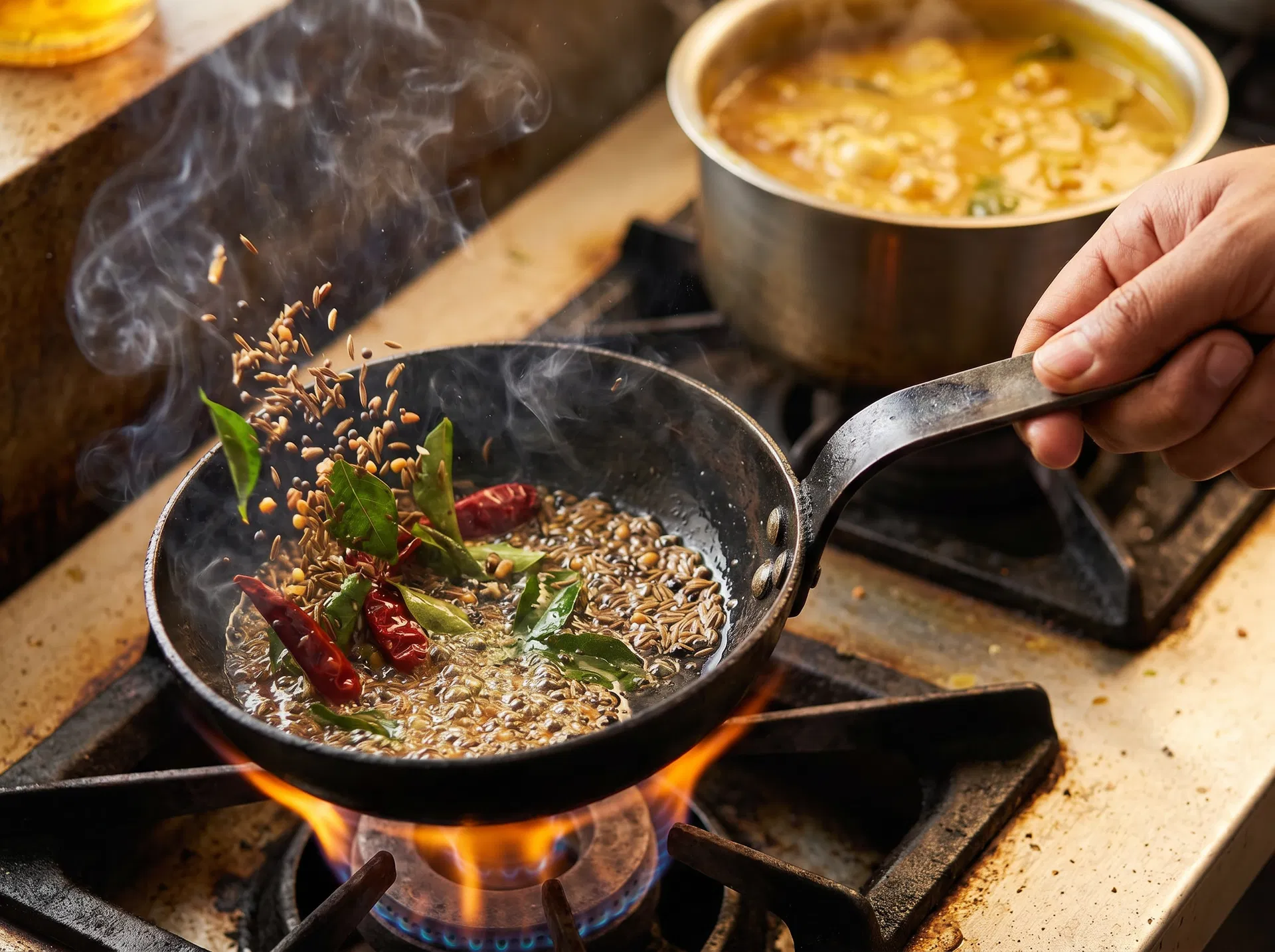
Curry
The art of tempering — chonk / tadka
A curry is not just ingredients in a pot — it is a sequence of transformations. The chonk (tempering) is the moment of alchemy: whole spices hit hot oil and explode into fragrance. Too early, they burn. Too late, they stay raw. The cook must feel the moment. Writing craft is the same — knowing when to add detail, when to hold back, when to let the heat do the work.
In the Kitchen
In Indo-Guyanese kitchens, the chonk is sacred. Cumin seeds, mustard seeds, dried red chillies, garlic, and curry leaves sizzle in hot oil until they pop and release their aroma. This tempered oil is poured over dhal or stirred into curry, transforming the dish from nourishing to transcendent. The technique was 'born of poverty and skillful seasoning' (Mackie, 1992).
At the Writing Desk
In Week 4, we learn the craft of bringing relatives to life on the page. Like tempering spices, good writing requires technique and timing — dialogue that crackles, scenes that simmer with sensory detail, and the restraint to let a moment speak for itself without over-explaining.
Voice & Narrative
Chutney
The accompaniment that completes the meal
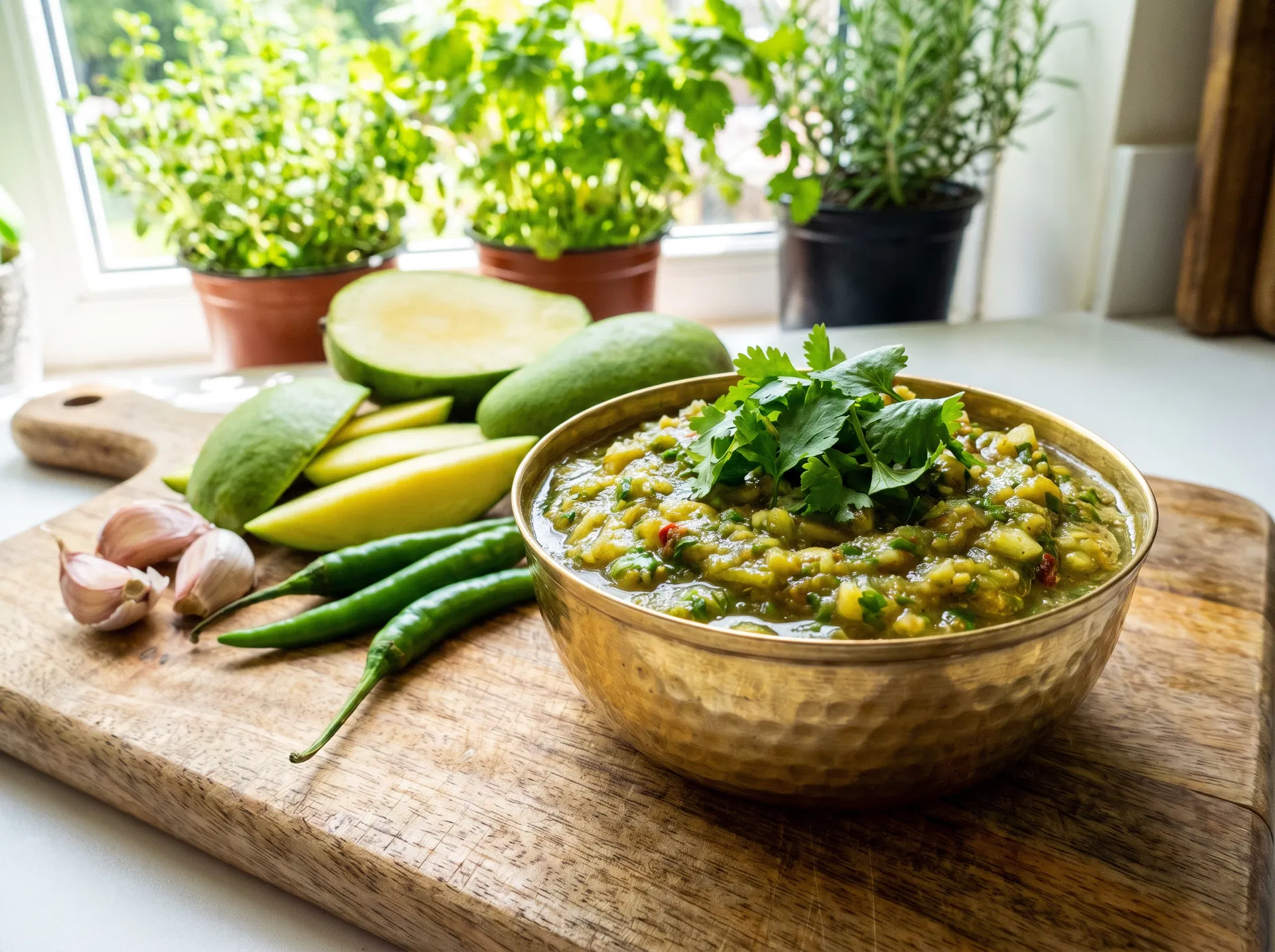
Every family's chutney is different. Some make it with green mango and garlic, others with tamarind and pepper, others with coconut and cilantro. The chutney is the personal signature — the thing that makes a meal distinctly yours. Finding your narrative voice is the same: it is the quality that makes your family's story sound like no one else's.
In the Kitchen
In the diaspora, chutney adapts to what is available. In London, green mangoes are swapped for unripe apples from the back garden. In Toronto, tamarind paste comes from the West Indian grocery. The recipe stays, but the ingredients shift — and each adaptation tells a story of place, of making the unfamiliar familiar once more.
At the Writing Desk
In Week 5, we develop our narrative voice. Like chutney, voice is personal, distinctive, and the thing that ties everything together. We learn to write in a way that honors both the formality of history and the intimacy of family — finding the tone that is uniquely ours.
Final Presentation
Cook-Up Rice
The communal one-pot that brings everything together
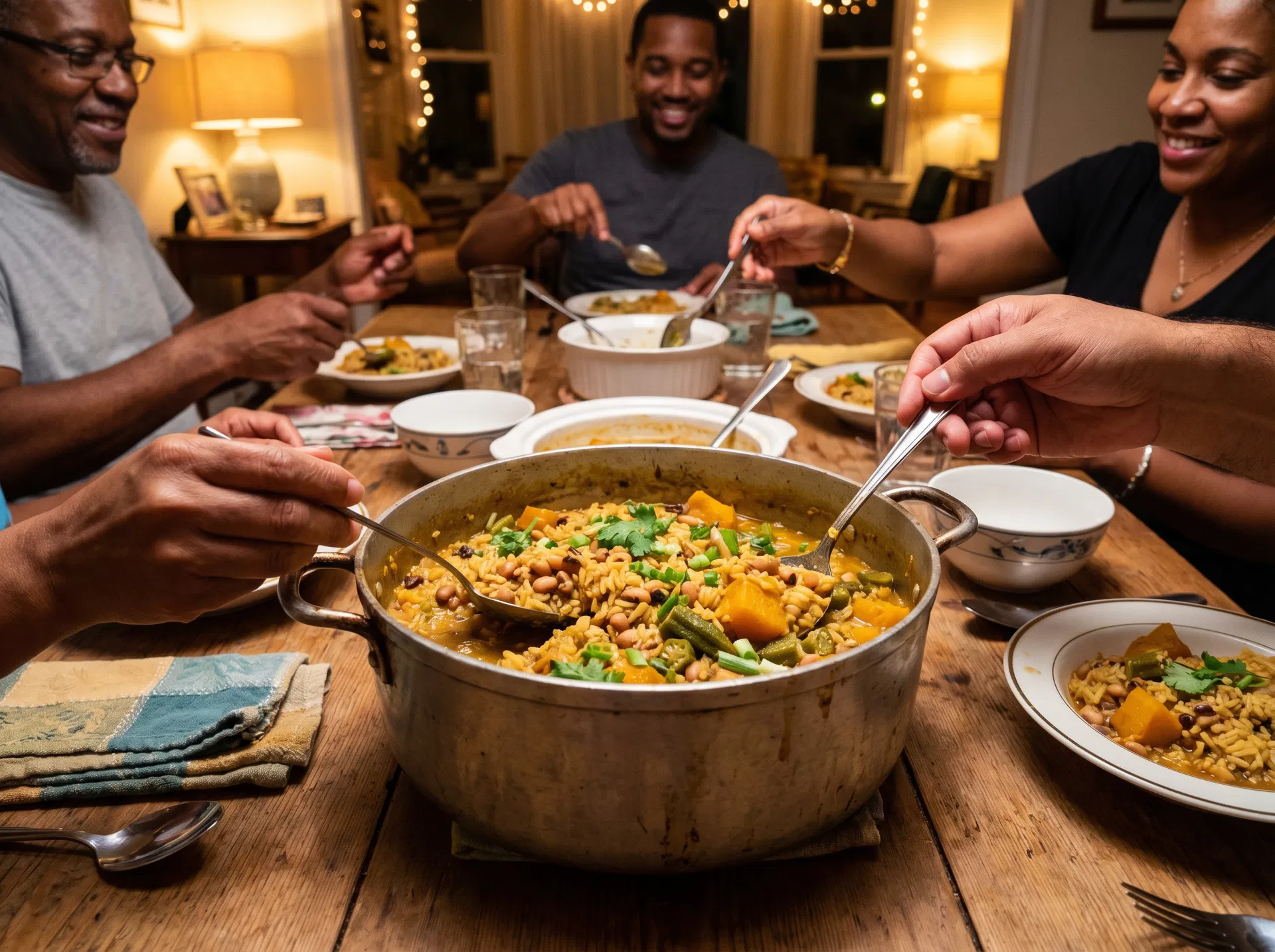
Cook-up rice is the great unifier of Guyanese cuisine — rice, black-eyed peas, coconut milk, and whatever the cook has on hand, all simmered together in one pot. It is the dish of gatherings, of family reunions, of coming together. Your final presentation is your cook-up: all six weeks brought together into one story, shared with your community.
In the Kitchen
Cook-up rice is never made for one person. It is inherently communal — a pot made for sharing, for feeding whoever walks through the door. In Guyana, it is the dish of Saturday nights and holiday gatherings, of lime (hanging out) and celebration. The beauty is that every cook's version is different, shaped by what they have and who they are feeding.
At the Writing Desk
In Week 6, you present the story you have built across the course. Like cook-up rice, your final presentation brings together all the ingredients — context, roles, rituals, craft, and voice — into something nourishing and complete. And like cook-up, it is meant to be shared: with family, with community, with the next generation.
From Kitchen to Page
The oral tradition of passing recipes between generations is a conduit for sharing much more than food. It is an act of cultural resistance and self-expression — a way of saying "we are still here, and we remember."
In this course, we honor that tradition by turning it into written stories that will endure for generations to come. Your family's kitchen is an archive. Your memories are the ingredients. The writing is the cooking.
"To empower the Indo-Guyanese diaspora to preserve cultural heritage and strengthen family bonds by transforming fragmented memories and oral histories into enduring family narratives for generations to come."
6 Dishes
Each mapping to a week of the curriculum
6 Prompts
Writing exercises rooted in food memory
5+ Generations
Of culinary memory preserved through oral tradition