Cultural Context
Understanding the
Indo-Guyanese Story
From the ships that carried indentured laborers across the kala pani to the kitchens of Queens and Toronto, the Indo-Guyanese story is one of resilience, adaptation, and enduring cultural memory.
Historical Timeline
From India to the Diaspora
1838
First Indentured Laborers Arrive
Following the abolition of slavery, the first ship carrying Indian indentured laborers arrives in British Guiana. They came primarily from the Bhojpur and Awadh regions of North India.
1838–1917
The Era of Indentureship
Over 238,000 Indians were brought to British Guiana across 358 shiploads. They signed contracts (girmit) to work on sugar plantations, often under conditions that echoed the slavery system they replaced.
1917
End of Indentureship
The last ship, the SS Ganges, arrives. The system is abolished after sustained activism in India and growing international pressure.
1950s–60s
Independence & Political Upheaval
Guyana gains independence in 1966. Ethnic tensions between Indo-Guyanese and Afro-Guyanese communities lead to political instability and the beginning of mass emigration.
1970s–Present
The Second Migration
Waves of Indo-Guyanese emigrate to New York (especially Queens), Toronto, London, and South Florida, creating vibrant diaspora communities that maintain cultural traditions while adapting to new homes.
Key Themes
The Threads That Bind
The Jahajee Bond
The word 'jahajee' (also spelled 'jahaji') refers to the bond formed between people who shared the same ship passage from India to the Caribbean. This connection was as strong as blood kinship — your jahajee bhai (ship brother) or jahajee bahin (ship sister) became family in a land where all other family ties had been severed. This concept of chosen kinship through shared hardship remains a powerful metaphor in the Indo-Guyanese community.
Double Migration & Identity
Indo-Guyanese people carry a unique dual-migration identity. Their ancestors left India — often involuntarily or under duress — and built new lives in the Caribbean. Then, a generation or two later, many migrated again to North America or the UK. This 'double displacement' creates a complex relationship with belonging: not fully Indian, not fully Caribbean, not fully American or Canadian. The Shaking the Family Tree curriculum helps participants honor all layers of this identity.
Food as Living Memory
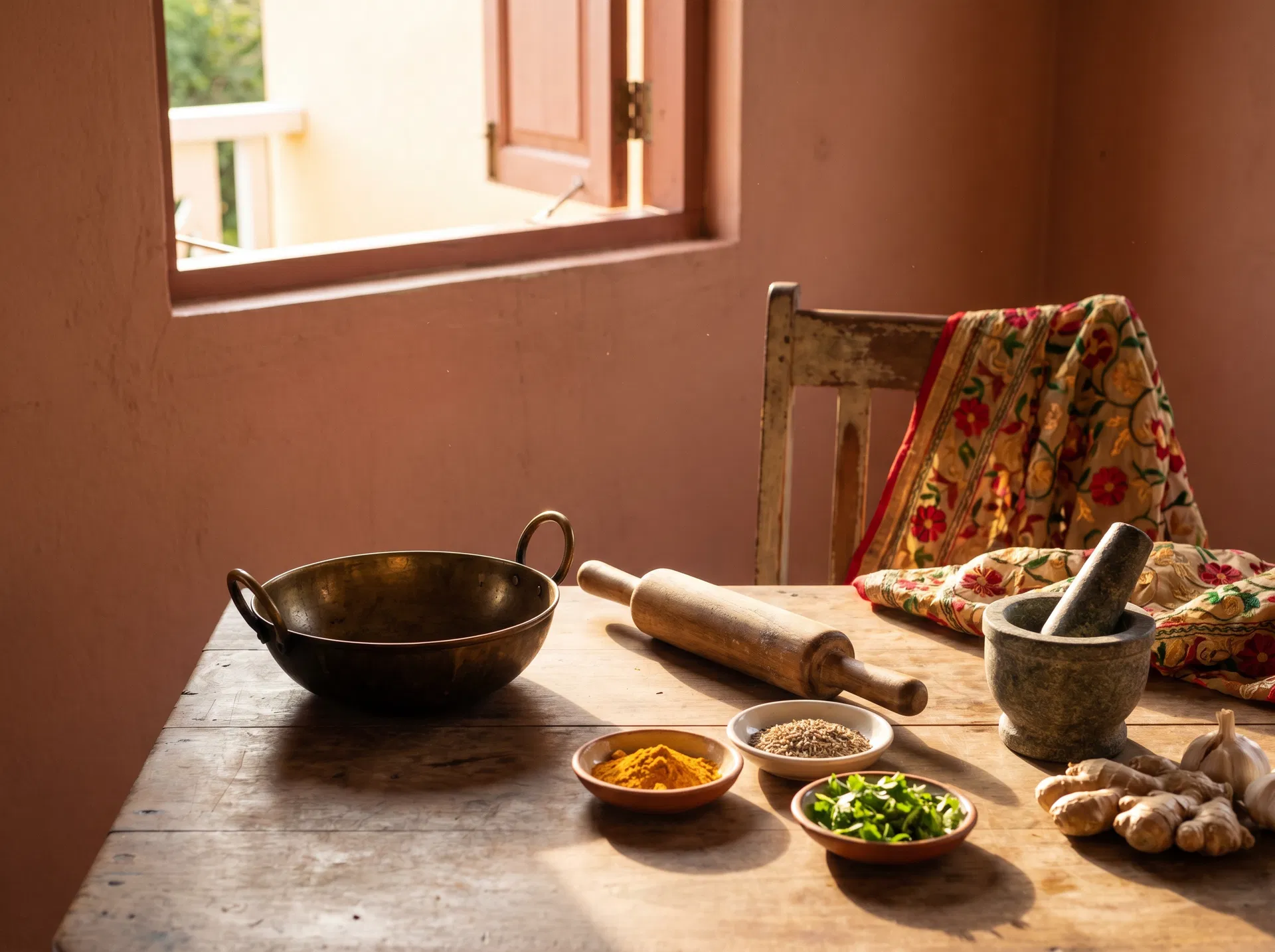
In the Indo-Guyanese diaspora, food is the most durable carrier of cultural memory. The act of making roti, curry, pepperpot, or chutney connects generations across continents. A grandmother's recipe carries within it the agricultural knowledge of Indian villages, the adaptation to Caribbean ingredients, and the nostalgia of a homeland twice-removed. When we write about food in the Family Tree curriculum, we are writing about survival, adaptation, and love.
Oral Traditions & Gyaffing
'Gyaffing' is a West Indian word for the rich, layered art of talking — gossiping, storytelling, debating, and nurturing all at once. In the Indo-Guyanese community, gyaffing happens in kitchens, on verandas, in mandir basements, and at weddings. These informal storytelling spaces are where family history lives. The Shaking the Family Tree curriculum formalizes this tradition, giving structure to the stories that have always been shared but rarely written down.
"I missed Guyana for a long, long time. Guyana was a state of mind for me. Even now, it's sometimes when I'm going to bed, I imagine myself back there, in a safe space — that's what it was."
— From the Ro(u)ted by Our Stories oral history archive, SAADA
Glossary
Key Terms
Girmit / Girmitiya
The contract (agreement) signed by indentured laborers; a girmitiya is one who signed it.
Jahajee / Jahaji
Ship sibling — the bond formed between people who shared the same ship passage from India.
Kala Pani
"Dark water" — the ocean crossing from India, which was considered a spiritual transgression in Hindu belief.
Gyaffing
West Indian term for chatting, gossiping, and storytelling — the informal oral tradition.
Mandir
Hindu temple — a central gathering space for the Indo-Guyanese community.
Orhni / Chunni
A traditional scarf or head covering worn by Indo-Caribbean women.
Creolese
The English-based creole language spoken in Guyana, blending English, Hindi, and African languages.
Puja
Hindu prayer ceremony, often held in homes or mandirs, a key community gathering event.